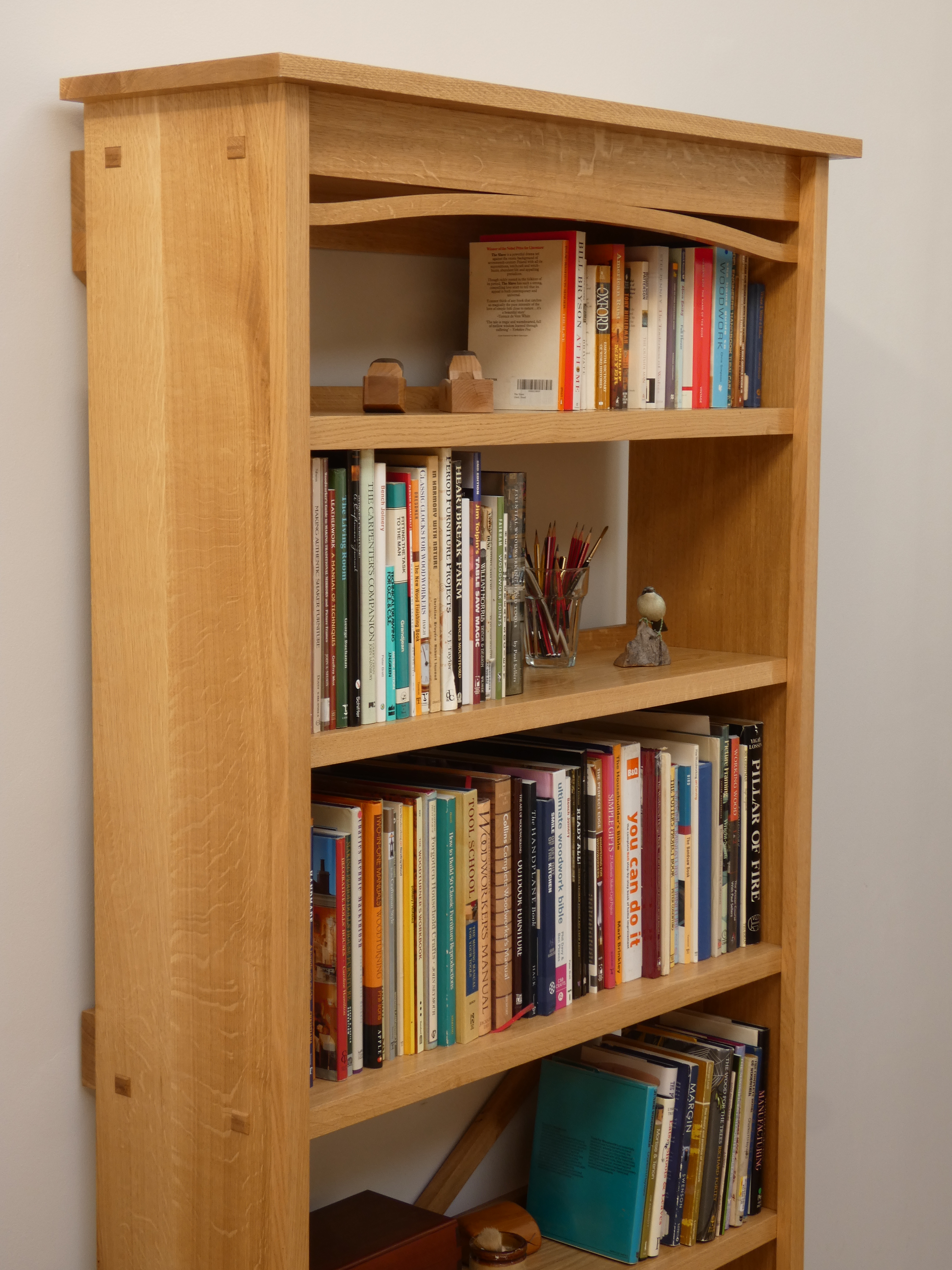
As of late, I’ve been pondering over the meaning of design. Not in the abstract or philosophical sense, but relating to woodworking. My questioning came about whilst making the Sellers Home Bookshelf, which was designed by Paul Sellers. He is the designer, there´s no question about that. In fact, I have intentionally decided not to experiment with furniture designs of my own. Why? Well, for one, I’m still an apprentice. I know I’ll always be one in a way, but what I mean is that, even though I began hand tool woodworking over ten years ago, I’ve never dedicated full time to the craft. Therefore, there’s not that great a variety of styles and designs that have influenced me that I could come up with something sufficiently unique. I couldn’t even say I have a real preference in style, but this is all beyond the point. Fundamentally, the reason I’m not particularly concerned about design is that I have the man Paul Sellers right here besides me, designing a houseful of furniture, piece by piece, with over fifty years of experience behind him as a maker and designer! So what better option than for me than to replicate these new pieces that Paul is currently working on; and especially considering he’s not making them for a client or because he needs the income, but because they’re his pieces for his own home! These designs are very precious to him and reveal something of his very essence; and had he had the chance, he would have started this project many years ago.
Anyway, back to the idea of design. I asked myself for a while (as I tend to do), “Why did this take me so long to make from start to finish? The design was there; the only real change I made was using oak instead of cherry.” After realising that what took me the longest was by far choosing the wood and deciding on the arrangement of each board, I soon remembered how quickly Paul’s students would finish their projects when he still taught classes in his workshop. The difference was that, back then, all the wood was milled, cut and ready to start laying out the joinery. Of course, even in that situation, the students were encouraged to take some time to look at each piece, find the nicest faces and decide on a configuration they were happy with. Was that an element of design? I think it was.

The thing is that we woodworkers don’t tend to think of this as a question of design. Most times we just work with what we’ve got and we pick the best faces. But however we may think of it, it’s a conscious choice regarding the appearance of the finished piece, therefore it must have to do with design. With certain woods (and depending on the application), there is no need to take into such consideration the grain direction, colour, figuring, etc; you simply check your material to spot any flaws that may cause problems and get on with the project at hand. Other times, you just need to make sure there’s nothing that looks too much out of place, which often means simply turning a piece around so that a light streak isn’t seen from the outside.
But this was different; I faced a twofold challenge. On the one hand, it was Paul’s design – one he developed for his very home, so I was under pressure to live up to the standard. And on the other, I was making it out of solid oak – a very traditional choice of wood long used for fine furniture. It was fitting, therefore, to go about it with a sense of respect for this wonderful material which has been so mistreated through cheap mass manufacturing methods that ultimately end up robbing it of its glory.
For the above reasons, something in me knew that this wasn’t going to be a straightforward task, even though I wasn’t fully conscious of what shape the challenge would take. My immediate concern was to source the raw material. I went to pick my wood in the middle of the heatwave back in July (2021), the day after Covid restrictions were first eased. Despite the 30° C (86° F), I spent a good hour or so going through a new batch of European Oak, as I really wanted something exemplary, especially for the sides of the bookshelf that are always exposed. I could have used perfectly straight grain and knot-free boards; this was an equally valid option which would have saved me a lot of time, but would have resulted in a standard replica of Paul Seller’s bookshelf. Again, there would have been nothing wrong with that: a great bookshelf in the typical oak colour and grain texture, and perfectly free of defects to enhance Paul’s intended design features.

I knew, however, that Paul hadn’t designed this bookshelf -or any of the other pieces in the living room- to be highly sophisticated examples of his workmanship, but rather sober, down to earth pieces, with a certain simplicity to them yet elegant nonetheless. I also knew that oak has quite a stunning characteristic that only shows when the boards are milled in a certain way, but must never be used carelessly on a piece of furniture: the medullary rays that glisten and reflect light differently according to the angle you look from. So despite the boards being rough sawn, I have learned to look past the coarse surface and appreciate the enclosed beauty even when it can’t quite be seen yet. One by one, I put aside each of these treasured radial cuts when they came up, even if a little bowed, cupped or with a knot or two right in the middle. I knew it would be well worth the effort.
I eventually came to the conclusion that there are different levels of design; the main part lies in the physical shape (geometry) and dimensions of the piece. The the rest has to do with the wood itself. Firstly (and most obviously), the choice of spices. But then there’s the selection of ‘cuts’ and finally the arrangement (composition) of each board in the whole.
While there are some practical issues related to these latter variables, they are mostly decided from an artistic side, at least at the small (non-industrial) scale we woodworkers are dealing with. It’s basically about working with an already designed (or composed) material which we have little to no control over. And this may be what most sets woodworking apart from other crafts. When we make, we unveil what is already there, and herein lies the importance of our attitude towards our work. Some may look at our work and only be interested in the physical design; others will seem indifferent to this and only appreciate the substance of the wood, but this shouldn’t bother us, if we have the humility to accept that the overall impression we’re after comes from a combination of both of these elements. The sooner we come to grips with this fact, the greater will be our enjoyment in our handwork and the notion of what privilege it is to be able to work with such material.

Clarifying Remark
Whilst I have no general objection to painting furniture, I believe that the pursuit of this ‘style’ to an extreme, where it becomes the norm, can take you to where you’re not so much an artisan but a furniture designer -even if you’re the actual maker. I say this because any (experienced) woodworker who has consciously looked at the substance he/she is working with cannot but be struck by awe at times, and that inevitably draws you to want to share the feeling with others, precisely by displaying -rather than covering up- a part of that amazement you experienced.
You can choose the wood for you work with different visions. I went out with a definite sense of expectation as I didn’t know what I would find. What I wanted was carefully selected timber that wouldn’t detract from the bookshelf design, but rather enhance certain features, whilst also seeing the bookshelf as a platform to display the wood itself and elevate it to a place of honour. This is what I intended, and I’m sure Paul wouldn’t be offended as he is frequently humbled by the wonder of wood, which only points to something greater than ourselves.
 Paul's Apprentice