This workbench was made according to Paul’s design, which is based on the traditional English Joiner’s workbench. Paul encourages all beginners in hand-tool woodworking to make a workbench very early in their journey, if not as a first project. It’s a rite of passage, to use his own words. Of course, it always takes some time to begin to see what Paul sees, and encounter the true power of the Craft, but making your own workbench from scratch using hand tools definitely helps to get there.

Why make this workbench?
It only takes a quick look to realise that this isn’t a highly sophisticated design. If it’s a good design, it’s because of its simplicity. Compared to other workbench designs, this is definitely among the simplest, yet performance wise, you can hardly fault it. What’s more, from an educational point of view, this workbench is just brilliant. The joinery is straightforward, fuss free and purely functional –apart from a basic aesthetic detail on the protruding tenons (my double tenons were a definite overkill). This helps to grasp the essence of joinery in a very real-life and applied situation. But it doesn’t end there, although it would certainly be a great project just as an introduction to joinery.
The first part of the workbench build (a good part of the project) is creating the main components. Now, you may be inclined to think that this basically involves planing and gluing up smaller sections of wood into larger parts. Yes, that’s right; however, you can either do it like I have done previously, going to great lengths to ensure each surface is perfectly straight, out of twist and square to the adjacent faces before gluing up (like a machine would do), or you can take this opportunity to gain invaluable insight into the very nature the craft.
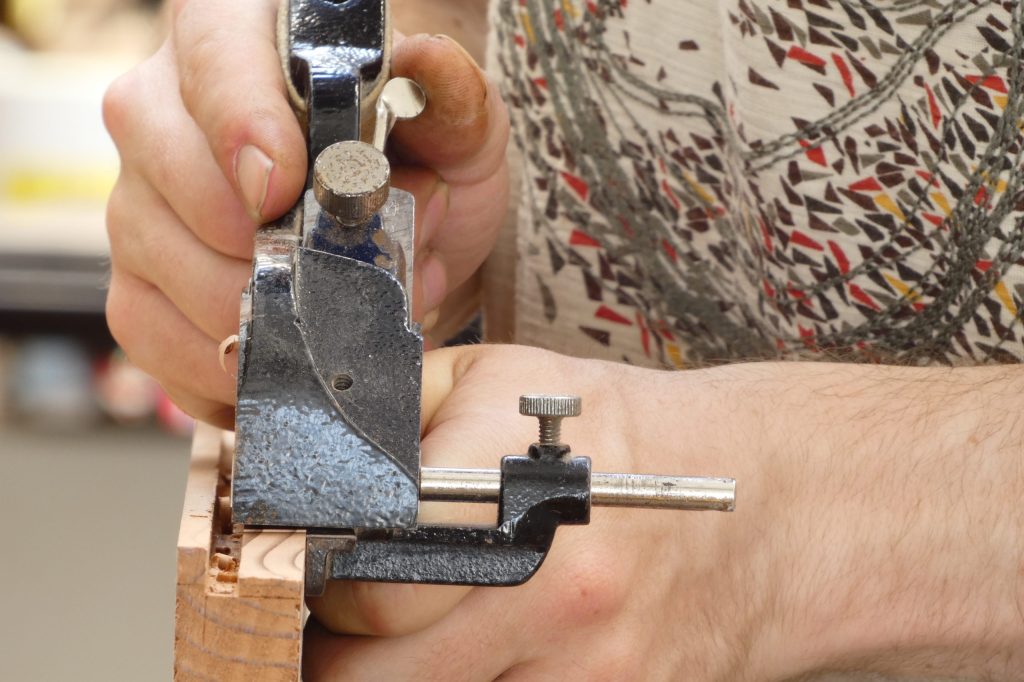
One of the pillars that constitute the craft of hand-tool woodworking is an understanding of the raw material; the wood. I do not mean the theory of it, i.e. its composition at a molecular level, though this sometimes can be useful. Rather, it means first-hand knowledge of the nature of wood as a dynamic material; it’s about practically knowing the limits of what you can achieve with wood, given you also have a solid understanding of hand tools, and of how these can be used to achieve different results when combined with another essential element: skill. In that regard, this project allows woodworkers to experience for themselves the elasticity and untold docility of wood, which is something machines cannot (and were never meant to) give you.
In essence, the craft has to do with keeping your eyes fixed on the goal and always knowing precisely to what end you are performing each specific tasks. That way, you focus your energy and attention only on the elements that really matter. This is the power of the craft, turning you and I into crafting men and women, a people of vision who won’t get distracted by all the noise that deafens because we refuse to take our eyes off the end goal.
Too deep? Well, there’s only one way to find out: source your wood and start building! Yes, the workbench can get you on the right track: can, not will, since your attitude (the humility that comes from realising that this is bigger than you) is a crucial element; and even that can take a while to come by, assuming you stay with hand tools long enough.
Anyway, if still in doubt, a quick online search will give you an idea of the thousands of men and women for whom making this workbench has set them on a life changing course.


 Paul's Apprentice
Leave a reply to Sylvain Cancel reply