Many beginners in hand-tool woodworking face the dilemma of choosing a first bench plane. Unfortunately, most resources attempting to provide orientation are unhelpful, to say the least, in that they fail to consider the fundamental question: what will the plane be used for. Instead, the issue tends to be address in a highly speculative manner, with naive and overly simplistic explanations about how the obvious differences (weight, width of blade) directly affect the plane’s performance. The basic error, however, is in ignoring what the different planes were developed for in the first place, or presuming that they were all intended for the same use.
Whilst both planes can be used effectively for a) truing (flattening) faces, b) surface-planing (smoothing) and c) general shaping tasks, it is the wider sole (and not the wider blade) what makes the No 4½ particularly advantageous for truing surfaces efficiently, in particular wider sections of wood. On the other hand, the narrower sole (and lighter weight) of the No 4 is better suited for smoothing surfaces that do not necessarily need to be flat, as well as for general shaping tasks (i.e. curves, roundovers), which often require taking quick, successive strokes.
I believe that anyone working with hand tools long enough will come to the same conclusions -that is, if they have any regard at all for productivity, which is a central element of the Craft. However, it is clear that very few of the ‘experts’ (including manufacturers and distributors of ‘high-end’ planes) know very much about the Craft, nor have any interest in it. I do not say this to criticise anyone, but to acknowledge that, just like there are clear differences between what is generally meant by ‘hand tools’ and the Craft, so too ‘woodworkers’, as famous as they may be, have different interests and objectives, and to ignore these will only continue to create confusion. This is a distinction that must be made if we want to see the Craft grow in the coming years, so I vow to post specifically on the issue in the next few weeks.
Going back to the focus of this post, I believe the proposed categories above for understanding the practical difference between the two bench planes will benefit those who, like me, wish to become better artisans, and this includes starting to look at the structure of the Craft more closely. I would encourage those who have been pursuing the Craft for a significant amount of time to take it into consideration and let me know whether it makes sense from personal experience, and if not, why.
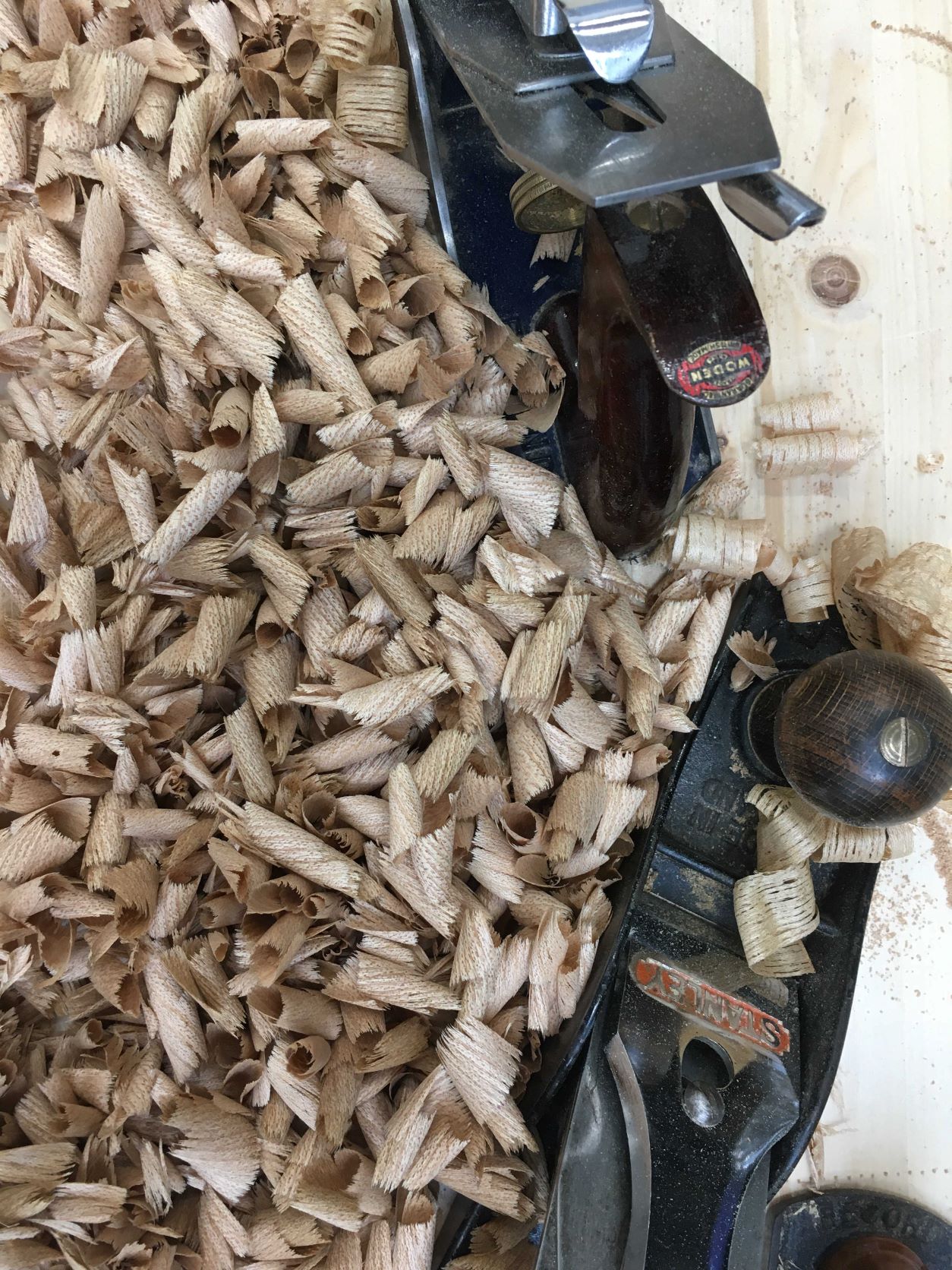
For those not satisfied with my simplistic view, I will now expand a little on this central idea and address some of the specific aspects related to bench planes which may, if anything, help to dispel some commonly held false ideas.
Smoothen or Flatten?
The central question, then, is what will the bench plane be used for? Depending on what exactly we are working on, our focus could either be on the texture of the finished surface -in which case our primary concern is to smoothen a surface, or we may be more interested in creating a specific geometry, i.e. getting a surface flat. Though this may be somewhat of a complex analysis in some cases, since we must achieve both of these tasks, we can generally recognise which one comes first. I do remember, for example, instances when I have been trying to achieve a smooth, finished surface, before realising the section had a significant bow or was clearly twisted. At that point, I would forget about the finish and focus on truing that face, since I could always go back in again later to clean-up the surface. This, of course, obeys the maxim ‘form follows function’. Therefore, when when know for sure what our main objective is for using a bench plane, it becomes easier to figure out which tool will be most appropriate; that is, most efficient at accomplishing that specific objective.
The popular obsession with flatness is a very new phenomenon -make no mistake. It certainly has a massive appeal to the ‘perfectionists’ who want things to be a certain way just to suit their fancy, but no doubt it is an idea the market has stirred up since it is easy to capitalise on (as with all over-engineered products, not least including bench-planes flattened to near perfection and all the sharpening equipment that guarantees ‘flatness’ even where it is far from essential).

Whilst the concept of ‘flatness’ has been hugely misused and overused in recent years, the concept of ‘smoothness’ is very much underused, and this seems surprisingly odd, given that most woodworkers are acquainted with the term ‘smoothing plane’ (with no equivalent term as a ‘flattening plane’. It should be noted here that getting a surface near perfectly flat is most often just a necessary prior step for a subsequent task, i.e. edge-jointing, joinery, etc. For outer surfaces of furniture and such, which do not have to correspond to other components, achieving a smooth finish is generally more important than flatness. What we have failed to realise is that the reason mass-made products flatten all faces (whether necessary or not) is because it’s a way of standardising production at little extra cost, but has no real additional benefit. In other words, it’s an overkill most of the time, so trying to imitate that with hand-tools is absurd. It is here where Paul’s teaching on Economy of Motion is crucial, because we are dealing with our own time and energy, so we cannot afford to spend these resources in extra work where the project doesn’t require it, nor will anybody appreciate it. We must stop and rethink what the Craft really is about, rather than follow the masses in imitating the so-called ‘experts’.
Weight
Back to the plane: It is true that for certain tasks, a heavier-weight plane can offer an advantage, but this does not in any way make the 4 ½ the “ultimate smoothing plane”, as Lie-Nielsen suggests on their website. The benefit of the increased weight is most noticeable when you are expecting to encounter a lot of resistance, i.e. when surfacing a tabletop that needs more work than just skimming the surface. Here, the increased mass means greater momentum as you take your stroke, so the plane is less likely to ‘slow down’ mid stroke (remember that an oiled sole is essential, especially in such instances as this, as friction will definitely slow you down).
On another note, but also regarding the issue of weight, it is often suggested that the No 4 was better suited to schoolchildren with their smaller stature. However, anyone who can confidently use a No 4 can also use a 4 ½ (my first bench plane was a 4 ½, and had no struggles as a skinny 17 year old). If, then, the No 4 was the plane chosen for use in schools, this wasn’t because of the student’s size, but because of the nature of the work they would be doing. Though some stock prep was probably involved, I can’t imagine it would have accounted for that much of the work that would justify the need for the wider No 4 ½’s. Now, if the question is whether a teenager (or anyone of small stature and not particularly strong) should choose a No 4 or a 4 ½ as their first bench plane, then of course I would say the No 4, but this would by no means be a compromise, and I would recommend the same to everybody (see conclusions below).
Width of Cut
Lastly, it should be clear to everyone that a wider plane with a wider blade will give you a wider shaving. however, it takes little experience to realise that this is not even something you are conscious of when surface planing your ‘average’ work for a given project, since the difference is most often marginal, if noticeable at all. Of course, when it comes to larger, wider sections (and multiple components), you will start to notice the difference.
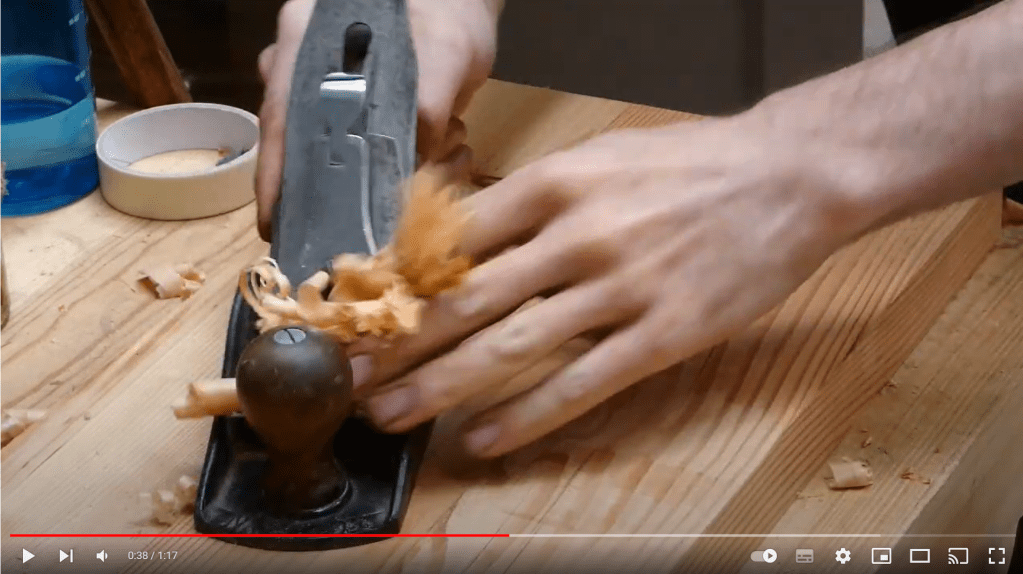
In the following video, I am experimenting surfacing a relatively wide section of wood with a No 4 ½ plane fitted with a narrower cutting iron assembly (from a No 4 plane). The point was to show that it feels and works pretty much the same as with the original, wider cutting iron installed. The cutting edge, although not as wide, is catching the highs to the degree that the wider plane sole allows, and this is why I would go for the 4 ½ in instances like this. Again, those who have the option, experiment and see what it feels like.
Conclusion
It takes a lot of use (and thinking) to realise why we reach for the tools we do (if we do it long enough). In the short term, we may go in cycles, switch out of boredom, curiosity, to compare ‘quality’ of manufacture, aesthetic appeal, etc. In the long term (assuming we get over the enthusiasm of hand-tools in themselves and instead choose to pursue the Craft in first place), then when we stick to what works, and we usually never think about it again.
From the point of view of the Craft, the No 4 and the No 4 ½ planes are different tools and should not be seen as rivals competing for the same tasks. The advantages of the extra width of the No 4 ½ are only appreciated in certain context and with enough experience (since it is the experience that allows you to start valuing efficiency, or economy of motion). For this reason, the No 4 is the best starting point for everyone who wants to get into the Craft of Hand-Tool Woodworking. Even if you do eventually get a No 4 ½ , you will likely find yourself reaching for the No 4 more often than not, as is the case with Paul.


 Paul's Apprentice
Leave a reply to Joe Cancel reply